What Happens When People Struggle Together
There’s an old idea that shows up in different forms across cultures — that water carries a kind of memory, holding a trace of everything it’s passed through before it reaches you. We can’t speak to whether that’s true of water. But we’ve spent over a decade watching what happens on our courses, and we’re fairly convinced mud remembers something too.
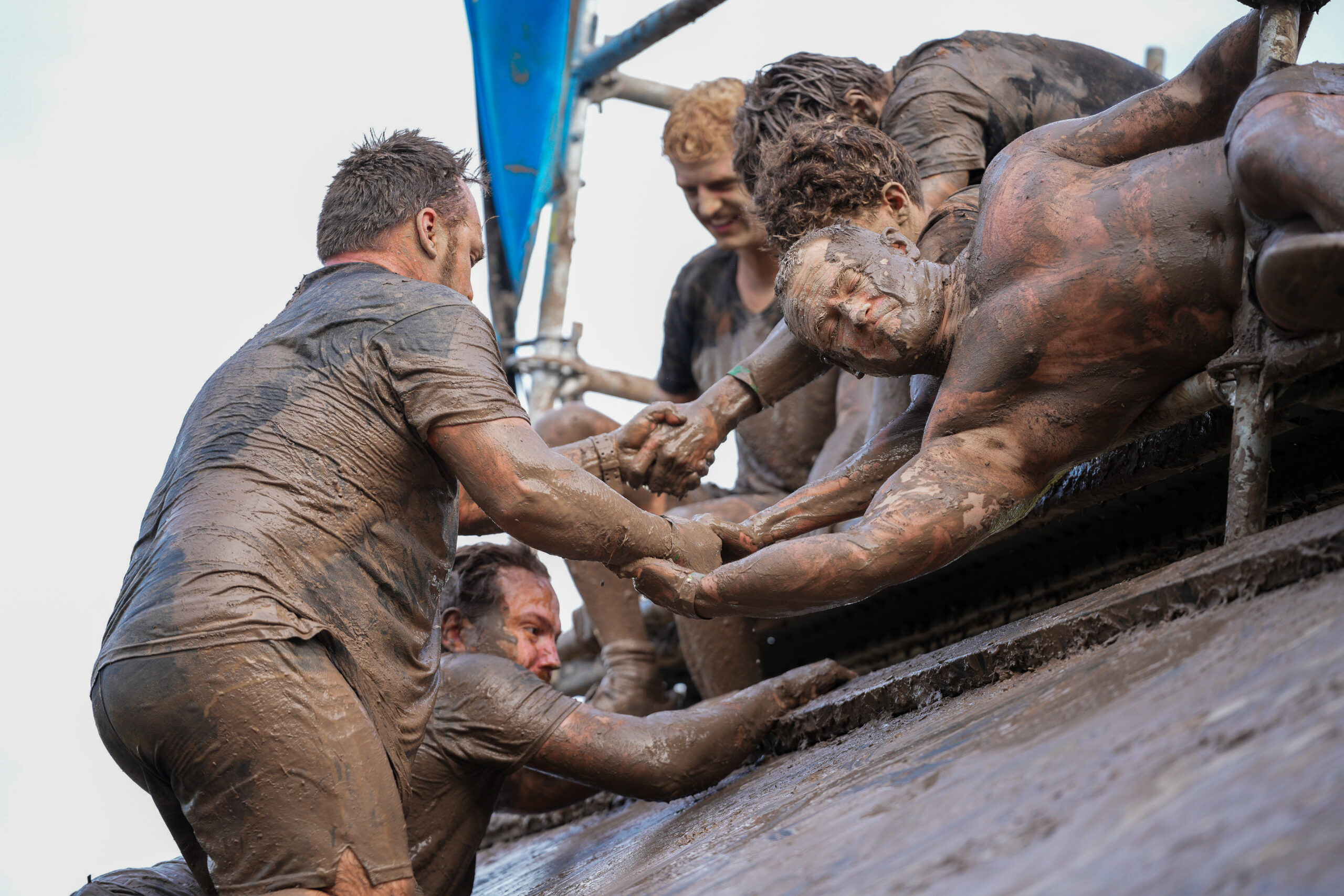
Not literally, obviously. Mud is mud. But the pit at the bottom of Everest has held the hand-prints, the near-misses, and the “I’ve got you” moments of thousands of people who came before you — and there’s something in that. You’re not the first person to go down face-first there. You won’t be the last. Somehow, knowing that makes the moment feel less like failure and more like initiation.
Why Shared Struggle Builds Something Individual Effort Doesn’t
Plenty of things build fitness. Not many things build community. The difference usually comes down to one thing: whether the hard part happened to you alone, or happened with someone.
Struggle Is a Faster Bonding Agent Than Comfort
You can spend a year being friendly with a coworker over coffee and know less about them than you’d learn from ten minutes stuck together on an obstacle, both of you covered in the same mud, both trying to figure out how the other person gets out first. Shared hardship compresses trust. It’s not comfortable, and that’s exactly why it works.
Nobody Remembers the Easy Parts
Ask anyone who’s finished a Tough Mudder event what they remember, and it’s never the flat stretch between obstacles. It’s the wall they couldn’t get over alone. The stranger who laced their fingers together to give someone a boost. The moment the whole group stopped to wait for the last person up the hill. Difficulty is what makes a memory stick — and shared difficulty is what makes it a memory that includes other people.
Community Isn’t Built by Being Around Each Other. It’s Built by Needing Each Other.
Proximity isn’t the same as connection. You can stand next to a hundred people at a gym and leave knowing none of them. But an obstacle that’s physically impossible to clear alone forces an actual interaction — a hand extended, a boost given, a “you good?” that gets an honest answer. That’s not an accident of course design. That’s the entire design.
The Mud Doesn’t Discriminate, and Neither Does the Bond
Whatever divided people before they hit the start line — job title, fitness level, how long they’ve known each other — tends to dissolve somewhere around the second obstacle. Everyone’s equally muddy. Everyone’s equally in it. That flattening effect is part of why crews that meet as strangers often leave as something closer to family.
What This Means for the Communities We Build
No Mudder Left Behind isn’t just a line on a t-shirt. It’s the reason strangers become training partners, training partners become crews, and crews come back year after year — not for the course, but for each other. The obstacles are just the excuse. The community is the actual result.
Crew Up
If you’ve got a group who’s been meaning to do something hard together, this is the nudge. Bring your Leader, your Rookie, your Wildcard — whoever needs a reason to show up.
Register Your Crew for Tough Mudder Victoria, February 13, 2027, at Caribbean Gardens, Melbourne.